Water in the crawl space: Atlanta homes
Water in the crawl space of an Atlanta home usually comes from a supply line leak, a sewer line under the house, or rain running toward the foundation. Find and stop the source, pump the water out, then dry the space below 60 percent humidity, the EPA's mark, before mold spreads on the joists.
Your call goes to an independent water damage company that works in the Atlanta area.
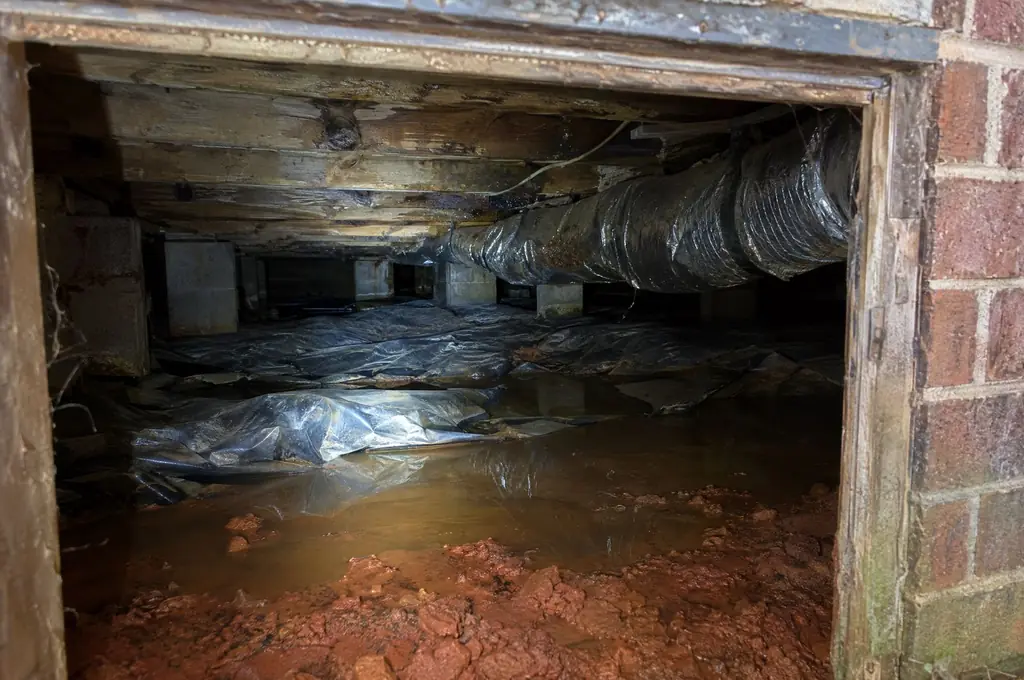
Illustrative photo.
Around Atlanta, crawl space companies often pitch encapsulation along with the dry-out, but those are two jobs. Getting the water out and drying the joists is water damage work; encapsulation, drains and sump pumps are waterproofing you can decide on later, once the source is fixed.
Right now
- 1Check whether the water is clean or smells of sewage; sewage changes everything about the cleanup.
- 2If you hear water running or the meter spins with every tap off, close the main valve.
- 3Don't crawl in if water is near the ducts, wiring or the furnace without the power off.
- 4Photograph the water level and the insulation from the access door, for your own records.
- 5Close crawl space vents and doors in a hard freeze; in summer, keep the access door shut so humid air doesn't flood in.
Atlanta facts for this problem
About 1 in 5 occupied single-family homes in the Atlanta-Sandy Springs-Roswell metro area sits on a crawl space: 389,300 of 1,868,400 in the 2023 American Housing Survey, against 811,100 on a concrete slab.
Source: U.S. Census Bureau, American Housing Survey 2023, Atlanta MSA, General Housing table, calculated by Atlanta Water Damage & Mold on November 14, 2026.
Under Atlanta's service line rule, every pipe from the meter to the house, including a supply line under the floor, is the property owner's.
Source: City of Atlanta Department of Watershed Management: Service Line Information.
The EPA advises holding indoor relative humidity under 60 percent, ideally in the 30 to 50 percent range.
Hartsfield-Jackson's 1991-2020 normals put 50.43 in. of rain on Atlanta in a typical year, with October the driest month at 3.28 in. and July the wettest at 4.75 in.
Source: NCEI 1991-2020 normals via ACIS, Atlanta Hartsfield-Jackson International Airport, calculated by Atlanta Water Damage & Mold on November 18, 2026.
September 2024, the month of Helene, brought 12.29 in. to the airport, ranked second among the airport's Septembers since 1928; the National Weather Service's September 2024 summary ranks it third on its own Atlanta list.
Source: ACIS daily record, Atlanta Hartsfield-Jackson International Airport, calculated by Atlanta Water Damage & Mold on November 18, 2026.
The median home in ZIP 30306 was built in 1956, the oldest median among those Atlanta ZIP codes (Census ACS 5-year).
Source: U.S. Census Bureau, ACS 5-year, tables B25034 and B25035, calculated by Atlanta Water Damage & Mold on November 14, 2026.
Georgia's Department of Public Health says mold work has no enforceable state or federal standards, so ask for the company's written plan.
Source: Georgia Department of Public Health: Indoor Air Quality.
Related on this site: the Atlanta rain and flood numbers for the wettest months and the normal year, and the mold remediation page for what Georgia does and doesn't regulate when mold has started.
The job, step by step
Keep this list handy: every step should turn up in the company's daily log or photos.
Find the source
Supply lines, the sewer line, the water heater, an AC condensate line and outside grading all get checked.
Pump out
Standing water is pumped and the soil surface is cleared of debris.
Remove wet insulation
Soaked fiberglass between the joists and a torn vapor barrier come out.
Dry the wood
Dehumidifiers and air movers dry the joists and subfloor to target readings.
Treat mold if present
Mold on joists is cleaned and the space is kept below 60 percent humidity.
How insurance usually treats it
A sudden leak from plumbing under the house is often covered after the deductible. Groundwater, rain seepage, long-term humidity and mold from it are often excluded. Your policy's water damage and mold sections say which applies.
General information, not insurance advice. Your policy decides. See flood insurance in Atlanta and Georgia's rules at a glance.
What changes the scope
- How much standing water and how long it sat
- Square footage of wet insulation to remove
- Whether the water was clean, rain water or sewage
- Mold on joists and subfloor
- Days of dehumidification needed under the house
No prices here. The company takes moisture readings in the house and writes its own itemized estimate, and the water damage estimator shows the lines that estimate ought to carry.
Questions people ask
Is a little water in the crawl space after rain normal?
Damp soil after a big storm is common, but standing water is not. It usually points to grading or gutters sending water toward the house, or to a leak. Either way the wood above should be dried before mold starts.
Do I need encapsulation?
Not to fix water damage. Drying the space and removing wet insulation is the damage work. Sealing the crawl space is a separate project you can weigh later, once the source of the water is fixed.
Whose pipe is leaking under my house?
Under Atlanta's service line rule, everything from the meter to the house is the owner's, and that includes a supply line running through the crawl space.