Water damage mitigation in Atlanta, GA
Water damage mitigation in Atlanta means stopping the water, extracting it and drying the house before mold starts. Call 404-546-0311 if the leak is between the street and the meter. For water already inside, close the main valve, photograph the rooms and start drying within the EPA's 24 to 48 hour window.
Your call goes to an independent water damage company that works in the Atlanta area.
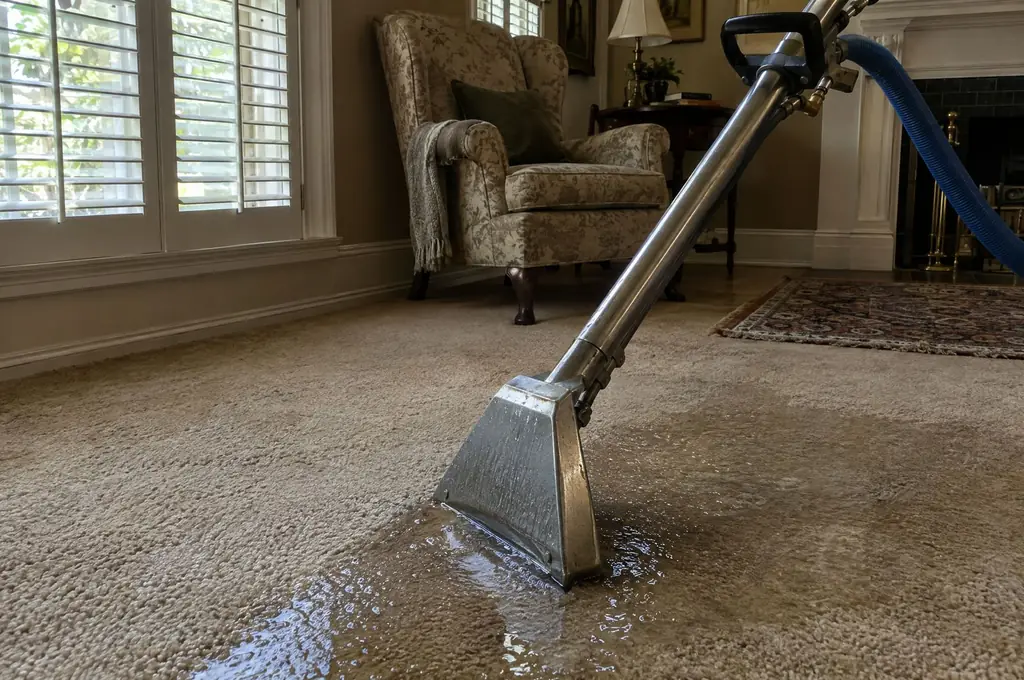
Illustrative photo.
In an Atlanta house, mitigation is the first week of the job: extraction, cutting out what can't be dried (often the carpet pad and the bottom of the drywall) and drying, checked with moisture readings until the oak, plaster or subfloor is back to normal. Rebuilding comes after, usually on its own estimate.
Right now
- 1Close the main water valve. Look where the water line comes into the house from the meter: often in the crawl space, a basement wall or a closet on the street side.
- 2If water is near outlets or a ceiling is sagging, stay out of that room and switch off its breaker only from a dry spot.
- 3Photograph every wet room, the source and any damaged belongings before you move them, for your own records.
- 4Lift rugs, boxes and furniture legs off the wet floor; slip foil under wood legs so they don't stain the carpet.
- 5Check the meter box at the street. Water bubbling up there, or a meter spinning with every tap off, belongs to the city's line at 404-546-0311.
Atlanta facts for this problem
Atlanta's Department of Watershed Management takes water and sewer emergencies after hours, on weekends and on holidays at 404-546-0311 (311 inside the city).
Source: City of Atlanta Department of Watershed Management: Contact DWM.
The department is responsible for the service line from the water main to the meter; the property owner is responsible from the meter to the house.
Source: City of Atlanta Department of Watershed Management: Service Line Information.
EPA guidance is to dry wet building materials and furnishings within 24 to 48 hours so mold does not take hold.
Hartsfield-Jackson's 1991-2020 normals add up to 50.43 in. of rain a year, wettest in July at 4.75 in.
Source: NCEI 1991-2020 normals via ACIS, Atlanta Hartsfield-Jackson International Airport, calculated by Atlanta Water Damage & Mold on November 18, 2026.
About 42% of the homes in the 22 ZIP codes this site lists inside Atlanta were built before 1980, according to Census estimates for ACS 5-year 2020-2024.
Source: U.S. Census Bureau, ACS 5-year, tables B25034 and B25035, calculated by Atlanta Water Damage & Mold on November 14, 2026.
When mains broke at Joseph E. Boone Boulevard and at West Peachtree and 11th Street on May 31, 2024, the city issued a boil water advisory and crews worked around the clock on repairs.
Source: City of Atlanta Department of Watershed Management: news release, June 2, 2024.
Related on this site: the Atlanta rainfall and humidity today for today's dew point, which decides whether open windows help drying, and the printable water emergency checklist for the city's line and the shutoff steps on one page.
The job, step by step
Keep this list handy: every step should turn up in the company's daily log or photos.
Find where the water went
Moisture meters and a thermal camera trace water under flooring and up into wall cavities, which usually reaches past the visible stain.
Extract
Truck-mounted or portable units pull standing water out of carpet, pad and subfloor so the drying gear has less to remove.
Remove what can't be dried
Soaked carpet pad, swollen baseboard and insulation come out. Drywall is often cut in a straight line above the wet edge to open the wall.
Dry and dehumidify
Air movers and dehumidifiers stay on around the clock. On a humid day the outside air can hold more water than the air you want indoors, so windows usually stay shut.
Check and document
Readings are taken each visit until every material reaches its dry target; ask the company for copies of its photos and moisture logs.
How insurance usually treats it
A standard homeowners policy usually treats water that escapes suddenly from plumbing or an appliance as a covered loss, after the deductible. It usually excludes flood, groundwater, long-running leaks and wear, and it may not cover the broken part itself. Your declarations page and the policy's water damage section say what yours does.
General information, not insurance advice. Your policy decides. See flood insurance in Atlanta and Georgia's rules at a glance.
What changes the scope
- How long water flowed, and how long it stood before anyone started drying
- How many rooms and floors it reached, and whether it went into the crawl space
- Hardwood, plaster or cabinets, which take longer to dry than carpet over a slab
- How much material has to come out
- Days of drying and how many machines run, which climbs in humid weather
No prices here. The company takes moisture readings in the house and writes its own itemized estimate, and the water damage estimator shows the lines that estimate ought to carry.
Questions people ask
What is the difference between water mitigation and water damage restoration?
Mitigation is the emergency part: extraction, tear-out of what can't be saved, and drying. Restoration usually means the rebuild that follows, new drywall, flooring and paint. Check which of the two an estimate includes.
Who pays for a leak at my Atlanta water meter?
Atlanta's Department of Watershed Management owns the line from the main to the meter, so a leak on that stretch is the city's repair. From the meter to the house the line belongs to the property owner.
Should I open the windows to dry the house?
Only when the air outside is drier than the air you want inside. On a humid Atlanta day it usually is not, and open windows just feed the dehumidifiers more water. The estimator shows today's dew point at the airport.
How long does drying take?
Often three to five days for a clean-water leak caught early, longer for hardwood, plaster, cabinets or a crawl space. The drying is finished when the moisture readings say so, not on a set date.